We offer our clients complete alodine finishing services, enabling them to capture faster turnarounds on their precision parts and giving them peace of mind that the high tolerance specifications for the final parts are met.
Many design engineers specify aluminum, assuming it has good corrosive resistance as it does not rust like steel. This is true for some applications. But in others, with exposure to oils, saltwater (even from human skin), or the need for electricity conductivity, the part will perform better if a coating is applied to the finished piece.
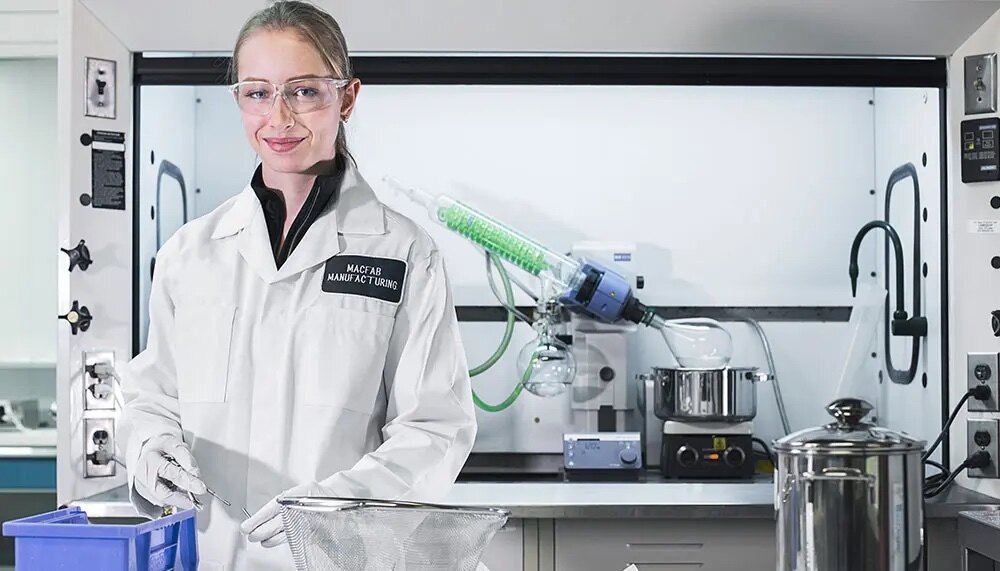
Alodine is a coating process that improves the part’s corrosion resistance without impacting the final dimensions of the aluminum part. Unlike the anodizing process, which has a similar effect as allodizing, an alodine finish functions as a primer and allows the part to be painted if required. This is due to the passivation process, which applies a coating to the part.
It is important to remember this is not a cosmetic surface finish and is meant to improve part performance, as seen in the table below:
| Industry | Benefits to final product | Product Example |
|---|---|---|
| Consumer and Medical Goods | Reduces corrosion and primer for paint | Aluminum handles |
| Electrical Components | Reduces electrical conductivity loss between parts | Heat sinks |
| Marine and Port Machinery | Improved corrosion resistance to salt water | Cover plates |
| Aerospace | Improved part longevity | Flight controls and landing gear components |
Our customers that specify this process typically come from these recognized international standards.
| Organization Issuing | Standard Number |
|---|---|
| United States Department of Defense | MIL-DTL-5541 |
| International Standards Organization (ISO) | 8081 |
| Society of Automotive Engineers (SAE) | AMS 2474, AMS 2473 |
| American Society for Testing and Materials (ASTM) | B449, B921 |
At Macfab, we have focused our process on meeting the MIL-DTL-5541 standard, as it is the most robust and offers the best foundation for meeting our customer requirements. The table below provides a quick overview of the standard.
| Type 1 (Hexavalent Chromate) | Type 2 (Hex-Free Chromate – Trivalent Chromate)1 |
|
|---|---|---|
| Class 1A | Maximum corrosion protection | Maximum corrosion protection |
| Class 3 | Less corrosion protection, improved electrical conductivity | Less corrosion protection, improved electrical conductivity |
| Process Steps | Clean Parts | Acid or Alkaline Clean |
| Rinse | Rinse | |
| Etch | Coat | |
| Rinse | Rinse | |
| Deoxidations (Deox) | 2nd Rinse if needed by coating material | |
| Rinse | ||
| Coat | ||
| Rinse | ||
| Warm Rinse | ||
| Note 1: Type 1 is tightly regulated environmental protection agencies, and Type 2 was developed as a more environmentally friendly process | ||